Looking for software to streamline your purchase order process? We’ve compiled a list of 8 top picks that promise to benefit businesses of all sizes. From well-rounded purchasing suites to web-based applications, there’s something for everyone. Here’s a brief overview of each option: 1. Coupa Procurement: Offers a full purchase order process, requisitions, budgeting software, spending and fraudulent activity guards, inventory management, and contract management. Pricing information is not publicly available. 2. Spendwise: A web-based application designed to optimize organizational spending. Offers a free 30-day trial, with basic plans starting at $9/month and premier plans costing an average of $19/month. 3. Precoro: Eliminates manual work processes to save time, resources, and money. Offers three plan levels: small ($29/month), medium ($24/month), and large ($19/month). 4. Fraxion: A procurement and accounting software that emphasizes spending less money in the course of normal busine...
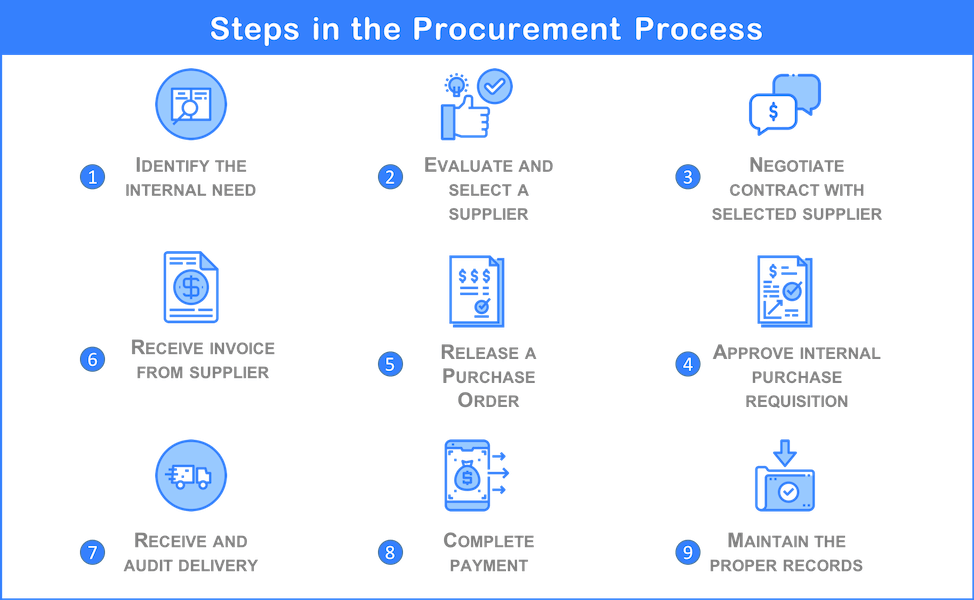
For most growing companies, procurement has long been and remains a thorny issue. Despite the best intentions and smart people involved, this process still leads to misunderstandings, paperwork, and stress . It's no surprise, then, that new methodology and technology has appeared to simplify key steps. We’ve written about the differences between procurement and purchasing and our favorite procurement tools in the past. There are also purchasing cards, a powerful weapon to make all of this easier. In this post, we're going to explore the procure-to-pay process in more detail . This systematic approach to procurement should be a priority. So let's get into it! Procure-to-pay is the specific process used by businesses for effective procurement. It involves integrating accounts payable and purchasing software to easily manage each step of the procurement process . At its most simple, procure-to-pay requires four key steps, each of them tracked and transparent for users: Procur...
The pandemic of COVID-19 led to a significant reshaping of how businesses operated. With lockdowns implemented globally, it became increasingly challenging to manage businesses traditionally; a more robust approach had to be adopted. Failure to adapt to this led to numerous companies coming to an end. Hence it became imperative for companies to cut costs and change their procurement practices for the sake of business continuity. While most companies faced challenges adapting to the harsh external global conditions, many thrived by implementing different strategies in their processes. When it comes to Fintech Industry, from 33% in 2017, 64% of customers globally now use one or more fintech platforms. Moreover, by 2025, the value of the worldwide FinTech industry is predicted to be over $305 billion. Let’s look at how strategic sourcing, specifically, has impacted the Fintech Industry. Strategic Sourcing and Its Impact on Fintech Industry Strategic sourcing ...
Comments
Post a Comment